Crawlspace Mold Remediation and the Three Risks That Matter Most
Finding mold under your home creates an uncomfortable mix of questions. You might wonder whether the floor joists are rotting, whether your family is breathing contaminated air, or whether termites have already found the same damp wood. Online explanations often present every possibility as an emergency, leaving homeowners with more fear than clarity. The more useful question is not how frightening crawl-space mold sounds. It is what the mold reveals about your home's condition.
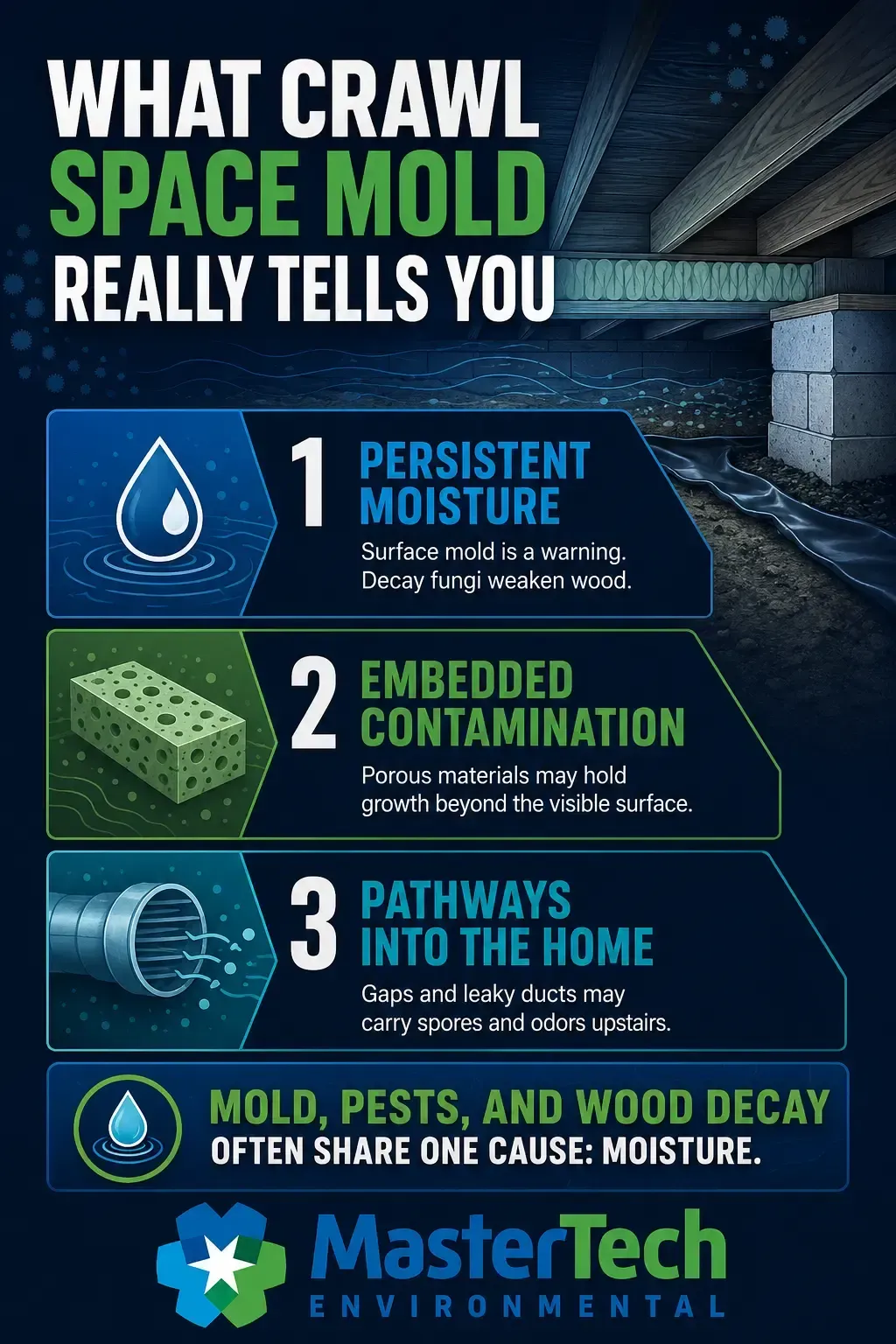
For Myrtle Beach homeowners, the need for crawlspace mold remediation should center on three evidence-based concerns. The first is whether persistent moisture has created conditions conducive to material deterioration and the growth of wood-decay fungi. The second is how deeply mold has contaminated insulation, subflooring, and other porous materials. The third is whether fungal particles are moving from the crawl space into occupied areas. Structural damage, indoor-air concerns, and pest activity all matter, but science draws important distinctions between what mold causes and what the underlying moisture problem causes.
Why Common Crawl-Space Mold Warnings Miss the Most Important Point
| Common warning | What the evidence supports | What determines the level of concern |
| Mold is rotting the floor joists | Ordinary surface mold usually has little effect on wood strength. Wood-decay fungi produce structural deterioration. | Wood moisture, softness, deformation, and evidence of active decay |
| Crawl-space air always enters the home | Air movement depends on floor openings, pressure differences, HVAC operation, and duct leakage. | The connection between the crawl space, duct system, and occupied rooms |
| Black mold is more dangerous than other mold | Color does not identify toxicity or establish exposure risk. | Moisture, contamination extent, affected materials, and occupant sensitivity |
| Mold attracts termites and carpenter ants | Mold and pests often share the same moisture source. Mold does not create the damp conditions. | Wet wood, decay, pest access, and existing insect activity |
| Surface treatment solves the problem | Mold often penetrates porous materials and returns when moisture remains active. | Material type, contamination depth, and whether the moisture source continues |
These corrections do not make crawl-space mold unimportant. They identify where the real risk sits so the response matches the condition. The Environmental Protection Agency states that indoor mold growth indicates a moisture problem and that cleanup without moisture correction often leads to renewed growth. Its residential guidance also stresses that mold damages the materials supporting it over time. EPA guidance updated in 2026 places moisture control and physical cleanup at the center of a responsible response.
The First Priority Is What Persistent Moisture Is Doing to the Wood
Dark or fuzzy growth on a floor joist does not automatically mean the joist has lost structural strength. Surface molds generally consume sugars, starches, and other substances in or near wood-cell cavities. They do not ordinarily digest the primary structural cell walls that support weight. The USDA Forest Products Laboratory reports that mold and stain fungi affect wood strength only slightly in most circumstances, with their greatest effects involving appearance, absorbency, and some toughness properties. The USDA's 2021 Wood Handbook chapter therefore separates visible surface growth from structural wood decay.
Decay fungi behave differently because they attack the cellulose, hemicellulose, or lignin forming the wood structure. The same USDA source reports that serious decay generally requires wood moisture levels above the fiber saturation point, which averages around 30%. Mold often develops under less severe moisture conditions, so it sometimes appears before the wood becomes wet enough to cause advanced decay. Visible crawl-space mold is therefore an early warning about moisture exposure, not proof that the framing is already rotten. The urgency rises when damp conditions persist long enough for decay fungi to become established.
Once decay begins, wood might lose substantial strength before the damage looks severe. A 2022 USDA Forest Service review examined methods for detecting biological deterioration before obvious failure. The researchers reported historical test findings showing a 50% reduction in toughness with only a 1% loss in wood mass under laboratory decay conditions. The USDA review also explains that bending strength and stiffness decline as fungal decay progresses. Those findings support taking persistent moisture seriously while avoiding the inaccurate claim that every patch of surface mold is consuming the joist.
The progression is easier to understand when each condition is kept separate:
- Surface mold grows on damp wood and produces staining, spores, and odors. Its presence identifies a moisture condition requiring attention.
- Wood-decay fungi attack structural wood components after sufficiently wet conditions persist. This process results in softness, cracking, deformation, and loss of strength.
- Sagging or uneven floors may be a result of established structural deterioration. Mold color alone does not establish that level of damage.
For Myrtle Beach homes, this distinction is especially useful because coastal humidity, wet soil, plumbing leaks, and storm-related water intrusion create several paths for crawl-space moisture. A homeowner does not need to assume the house is failing after finding mold. The discovery does mean the environment under the home has supported fungal growth. The central concern is whether the moisture remains active and whether the affected wood shows evidence of decay beyond surface contamination.
The Second Priority Is How Deeply Materials Have Become Contaminated
The visible area rarely tells the whole story when mold reaches porous materials. Crawl spaces contain insulation, wood joints, subfloor seams, paper facings, and small cavities where fungal growth is difficult to remove completely. Surface wiping might improve appearance while leaving contamination embedded inside the material. The EPA explains that mold grows into the spaces and crevices of porous substances, making complete removal difficult or impossible in some cases. EPA remediation guidance updated in 2026 states that wet, mold-contaminated porous materials sometimes require removal and disposal.
Contamination depth matters because mold spores do not need to remain visible to remain present. Damp insulation sometimes holds moisture against the subfloor or framing, giving fungal growth more time to spread across hidden surfaces. Mold also increases wood's absorbency, according to the USDA Forest Products Laboratory, leaving affected wood more wettable and more vulnerable to subsequent colonization by decay fungi. The concern is therefore larger than a stain on one exposed face of a joist. The real issue is whether mold has entered materials or connections that ordinary surface cleaning will not reach.
Several conditions increase the potential remediation scope:
- Growth affecting removable insulation as well as the wood behind it
- Mold extending across several joist bays instead of one isolated surface
- Continued dampness inside wood, insulation, or subflooring
- Contamination near ductwork, floor penetrations, or other connections to occupied rooms
- Material deterioration that prevents effective cleaning and reuse
This is why crawlspace mold remediation involves more than applying a chemical and waiting for the stain to fade. EPA guidance recommends physical removal of mold contamination, proper handling of unsalvageable materials, and HEPA vacuuming after contaminated materials have been removed. The agency also warns against painting or caulking over moldy surfaces, as coatings applied over contaminated areas are likely to fail. A clean-looking surface does not resolve embedded growth, active moisture, or contaminated debris.
The Third Priority Is Whether Contaminants Are Reaching Occupied Areas
A crawl space is separated from the living area by a floor assembly, but the boundary is rarely airtight. Plumbing penetrations, wiring openings, framing gaps, utility chases, and leaky duct connections create paths between the two spaces. Airflow through those paths changes with weather, HVAC operation, exhaust fans, and pressure differences inside the home. The EPA warns that operating an HVAC system contaminated by an identified moisture problem might spread mold through the building. The agency's 2026 residential mold guidance supports evaluating the connection rather than assuming every crawl space contributes the same amount of air.
Claims stating that 40%, 50%, or 60% of household air always comes from the crawl space are not reliable for every property. Air-transfer rates depend on construction, leakage, duct location, ventilation, and operating conditions. A tightly separated crawl space presents a different exposure pathway than one containing return-duct leaks and numerous floor penetrations. The scientifically defensible point is simpler. Crawl-space contaminants can enter occupied rooms, but the extent of transfer varies from house to house.
Fungal particles deserve attention without turning the discussion into a list of frightening illnesses. Mold releases spores into the air, and settled spores form new colonies when they reach another damp surface. The CDC explains that mold exposure is associated with nasal irritation, coughing, wheezing, allergic responses, and worsening asthma in susceptible people. CDC guidance updated in 2025 also notes that damp indoor spaces are associated with both existing asthma symptoms and new-onset asthma. These findings support reducing indoor exposure while recognizing that individual responses differ.
Get a Clear Answer about What Is Happening Under Your Home
You should not have to choose between ignoring crawl-space mold and assuming the worst about your home. MasterTech Environmental of Myrtle Beach evaluates the moisture conditions, affected materials, structural surfaces, and potential connections to occupied areas before developing a remediation plan. Our local team serves homeowners throughout Myrtle Beach, Conway, Horry County, Georgetown County, and Brunswick County.
For help with crawlspace mold remediation, call MasterTech Environmental at 843-236-3399 to schedule an assessment and learn what the conditions under your home mean.