Attic Mold Remediation in Myrtle Beach: What Should Happen Before Work Begins?
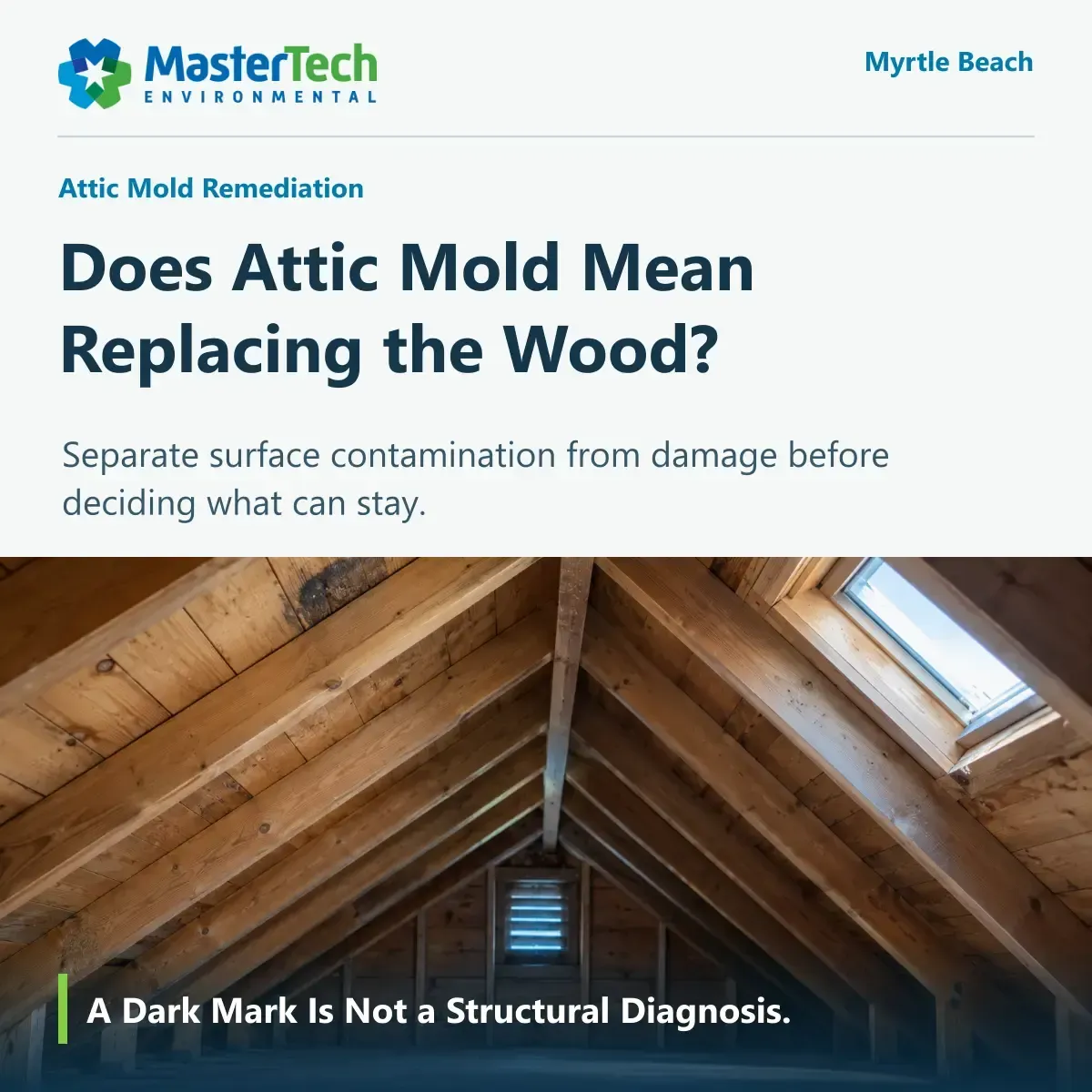
You find dark marks on the wood in your attic, or someone inspecting the house tells you there may be mold overhead. You want the problem handled, but you also want to know what actually needs to be done. Does every affected board need to be replaced? Will the work stay in the attic, or could it involve rooms below? Those are reasonable questions before agreeing to a remediation proposal.
At MasterTech Environmental, we approach attic mold remediation by separating three decisions that are often bundled together: what has been found, how much of the affected space can be examined, and whether the attic connects to the air moving through the house. Each decision affects what a contractor can reasonably propose. A visible mark, a laboratory result, and a dusty air handler do not all establish the same problem. Homeowners in the Myrtle Beach area deserve to understand the difference before work starts.
First, Identify What Is Actually Affected
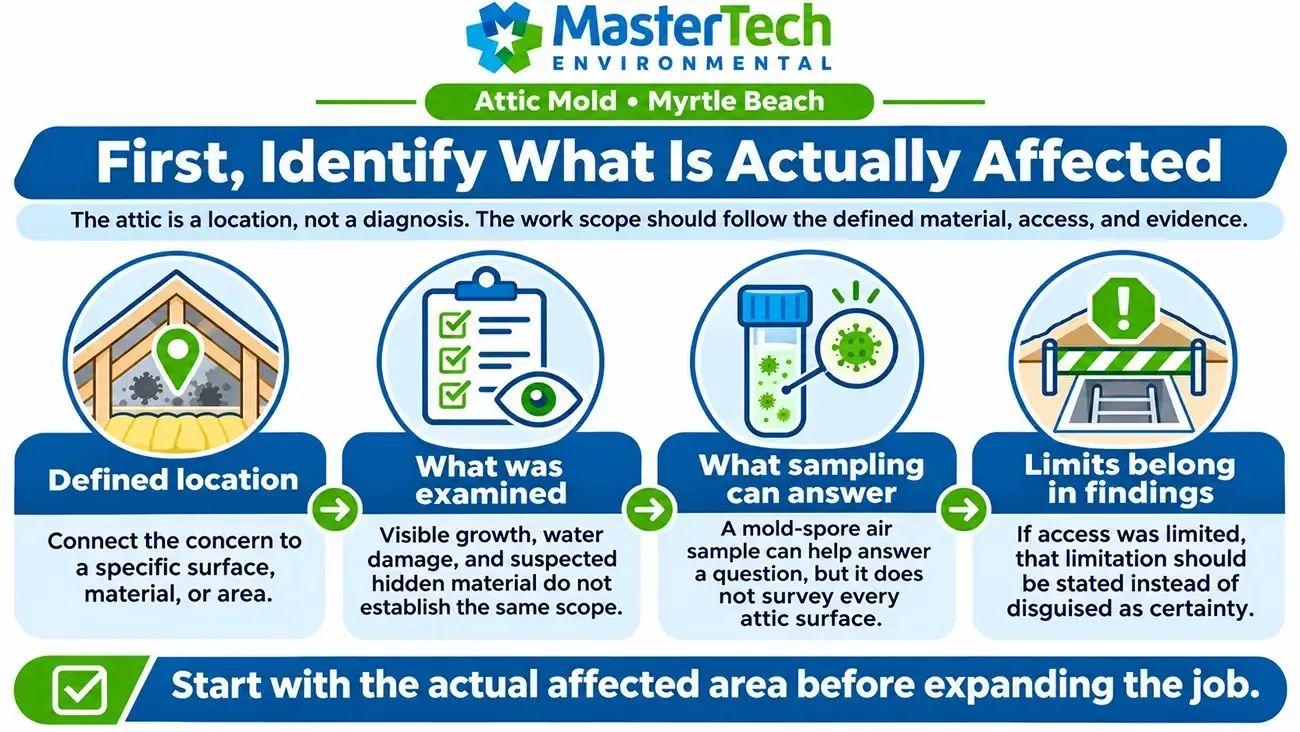
The attic is a location, not a diagnosis. A contractor might point to staining on exposed roof sheathing, an area that became wet, or an inaccessible space behind a finished wall. Those observations do not establish the same scope of work. We want the proposed work connected to a defined location, a documented concern, and an explanation of what was examined. If access was limited, that limitation belongs in the findings rather than being disguised as certainty.
One of the questions we examine is whether the concern involves visible growth, previous water damage, or material that is suspected but cannot yet be inspected. We consider moisture conditions, visible evidence, and sampling where it can answer an unresolved question. A mold-spore air sample is only one kind of measurement; it does not survey every surface in an attic. A low result does not tell the homeowner what is behind enclosed roof or wall materials. The investigation should explain what it knows before expanding what it proposes to remove.
Next, Understand Why Treatment May Differ
Not every attic finding leads to the same treatment recommendation. An attic mold finding, by itself, does not establish a need for specialized mycotoxin cleaning. Ordinary mold remediation and extensive small-particle cleaning are different scopes, with different reasons for considering them. A contractor should be able to explain the condition that justifies each service rather than simply adding one to the other. A mold name alone should not become a blank check for additional work.
That distinction is especially important when a proposal includes work beyond the visibly affected area. We start with identifying the material of concern and deciding what further evidence is needed before recommending specialized cleaning. Detailed surface cleaning is labor-intensive work that can extend well beyond removing mold-damaged material. If such work is proposed for your Myrtle Beach home, ask which observed condition calls for it and whether it is essential or optional. The answer should be specific to your house, not a standard package attached to every attic estimate.
Then, Account for Access and Air Movement
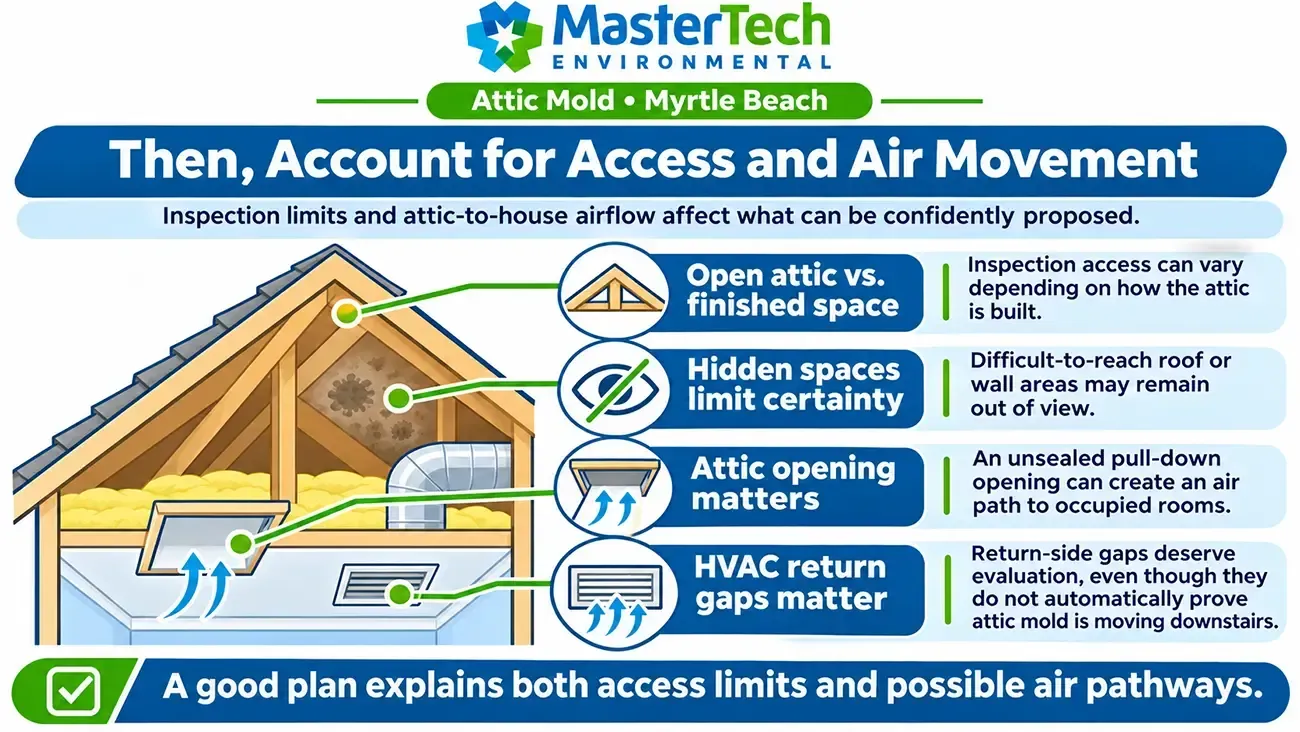
An open attic and a finished room built into the roof can present very different inspection challenges. We have examined an older converted attic where roof sheathing was difficult to reach and HVAC equipment occupied narrow spaces beside the finished room. Limited access matters because the inspector may see only the exposed side of a larger enclosed area. It does not establish that hidden material is damaged, but it limits what can be confidently ruled out. The work plan should identify those boundaries before anyone promises that the entire problem has been located.
We also pay attention to how the attic connects with the occupied rooms. An unsealed pull-down attic opening can provide an air path, while HVAC equipment and its return ductwork deserve attention where they share an attic space. We specifically examine return-side gaps because the system can draw nearby air through those openings when it runs. That observation does not prove that attic mold is being carried downstairs. It does mean the investigation should consider airflow rather than treating the attic as a sealed box above the ceiling.
Read the Proposed Scope Before You Agree
A useful attic remediation proposal should make the reasoning visible to a homeowner. It should identify where the concern was observed, which surfaces or materials the work addresses, what the contractor could not inspect, and what would prompt a change in scope. If additional sampling, duct cleaning, or extensive particle cleaning is suggested, the proposal should explain the question that service is meant to answer. These are not interchangeable extras, and a homeowner should not have to guess why each appears on the estimate.
Ask how the contractor will check the affected area after the work and what the result can actually establish. Particle counts and surface sampling can document specific conditions, but neither guarantees that every possible contaminant has been removed. The documentation should match the work that was performed and the conditions at the time it was checked. In a partially inaccessible attic, it should also say what remained out of view. That is more useful than a reassuring sentence with no defined inspection or completion criteria.
Make the Decision Based on Your Attic
Attic mold remediation should begin with a clear description of the affected area, not an assumption about how big the job will become. The right questions concern treatment scope, difficult-to-reach materials, and connections to the rest of the house. Those answers help you understand which work responds to an observed problem and which recommendations still need support. Before approving a Myrtle Beach attic project, ask for the findings and the proposed work to be explained together.